
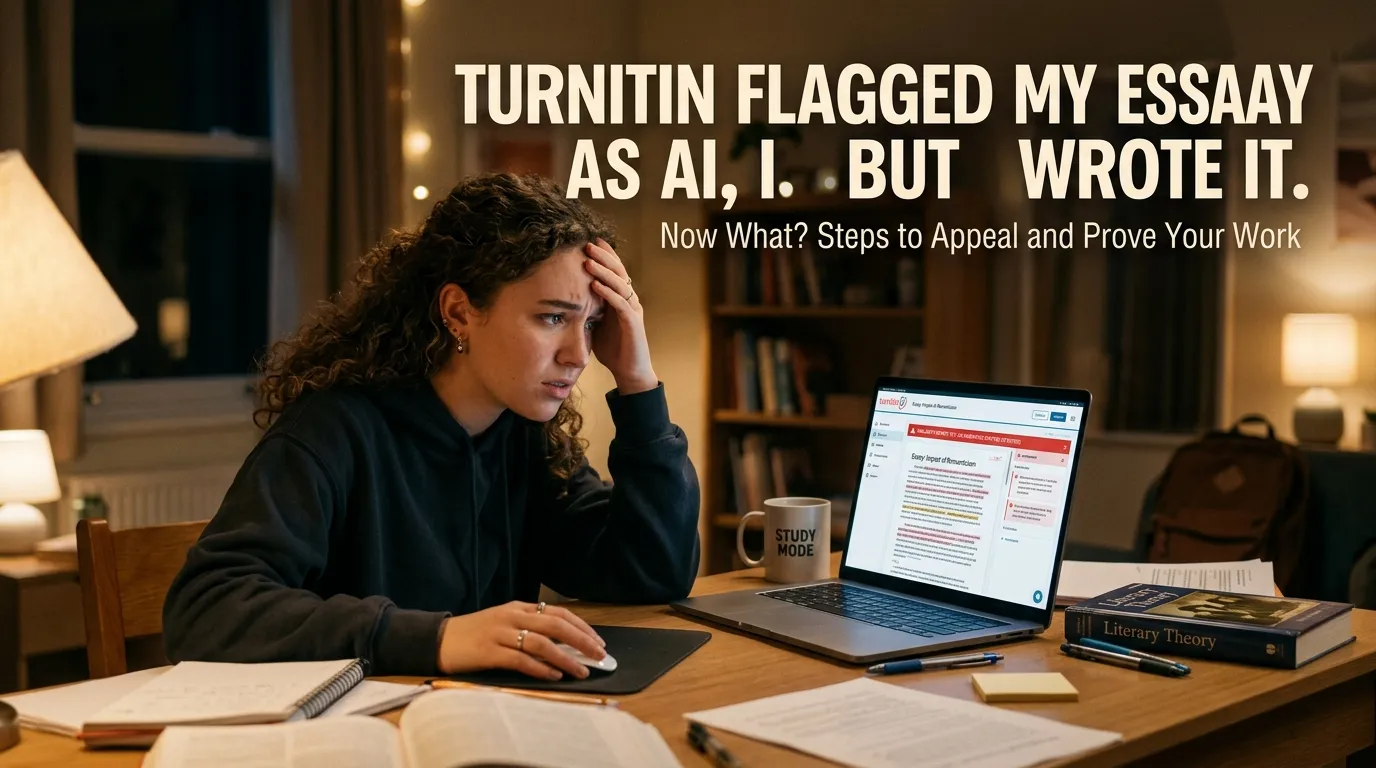
Turnitin Flagged My Essay as AI, But I Wrote It. Now What?
You spent a week on that essay. You wrote every line. And then your teacher emails you saying Turnitin gave it a high AI score.
It’s a horrible feeling. Part anger, part panic, part “wait, did I do something wrong without knowing?”
Take a breath. This happens more than you’d think, and there’s a clear way through it.
Why it happens to honest students
Turnitin doesn’t know who wrote your essay. It looks at patterns: how predictable your word choices are, how similar your sentences are in length, how closely your structure matches the millions of AI-written texts it has studied.
The annoying part is that good academic writing can look a lot like that. A clean five-paragraph essay with a neat thesis and tidy topic sentences is exactly the shape AI tools produce.
A few groups get caught more often:
- Students writing in their second language. Researchers at Stanford found AI detectors misjudge non-native English writing far more often than native writing. If you learned English at school rather than at home, your careful, simple sentences can look “machine-like” to a detector.
- Short submissions. Turnitin’s own guides say scores on texts under 300 words are less reliable.
- Heavily polished work. Running your draft through several grammar or rewording tools can smooth out the little quirks that make writing look human.
Turnitin itself says an AI score shouldn’t be the only reason to take action against a student. Some universities, including Curtin University in Australia, switched the AI detector off entirely at the start of 2026 over reliability concerns.
So a flag is a question, not a verdict.
What to do in the first 24 hours
Don’t send an angry email. You’ll want to. Don’t. Write it, then delete it.
Reply calmly and ask for a meeting. Something like: “I wrote this essay myself and I’d welcome the chance to show you how I worked on it. Could we meet this week?”
Collect your evidence before the meeting. This is where most students win or lose.
Evidence that actually convinces teachers
- Version history. If you wrote in Google Docs, open File > Version history. It shows your essay growing over days, with typos, deletions and rewrites. Nothing is stronger than this. Word users with OneDrive have a similar feature.
- Your notes and outline. Handwritten notes, a messy outline, a photo of your notebook. Anything that shows thinking before the final draft.
- Your sources. Browser history showing the articles you read, PDFs you downloaded, library records.
- Earlier drafts. Emailed to yourself, saved on a USB, sent to a friend for feedback.
- Your older work. A few past essays in the same style show this is just how you write.
In the meeting
Expect questions about your essay. Why did you choose that argument? What does this source say? What would you change?
If you wrote it, you’ll answer these easily, because you remember the decisions. That conversation often settles things faster than any document.
Bring a printed copy and be ready to talk through one paragraph in detail.
If they still don’t believe you
Ask, politely, for the school’s academic integrity policy in writing. Most institutions have an appeal process. You can usually ask for a second marker or a review panel.
Keep every email. Stay polite in all of them. It matters later.
How to protect yourself next time
- Write in Google Docs or Word with autosave on, so version history exists.
- Keep your outline and notes until the grade is final.
- Use tools for checking, not rewriting. A grammar checker that points out errors is fine. Pasting your whole essay into a rewording tool and accepting every change can make your writing look generated.
- Add your own voice. A personal example, a specific detail from class, an opinion you actually hold.
- Get your references right with a citation generator so nothing about your sources looks off.
- If you used AI for anything (brainstorming, checking a definition), say so. Many teachers are fine with it when you’re upfront.
One more thing
If you did use AI and got caught, the honest move is to say so early. Teachers usually respond better to honesty than to a denial that falls apart in the meeting.
But if you wrote it yourself, stand your ground, calmly, with evidence. You’ve got more of it than you think.
FAQ
Can Turnitin be wrong? Yes. Turnitin calls its score an indicator, and independent research has found false positives, especially with non-native writers.
What AI percentage is considered cheating? There’s no universal number. Each school sets its own policy.
Will using a grammar checker get me flagged? Fixing errors, usually no. Letting a tool rewrite whole sentences can raise the score.