
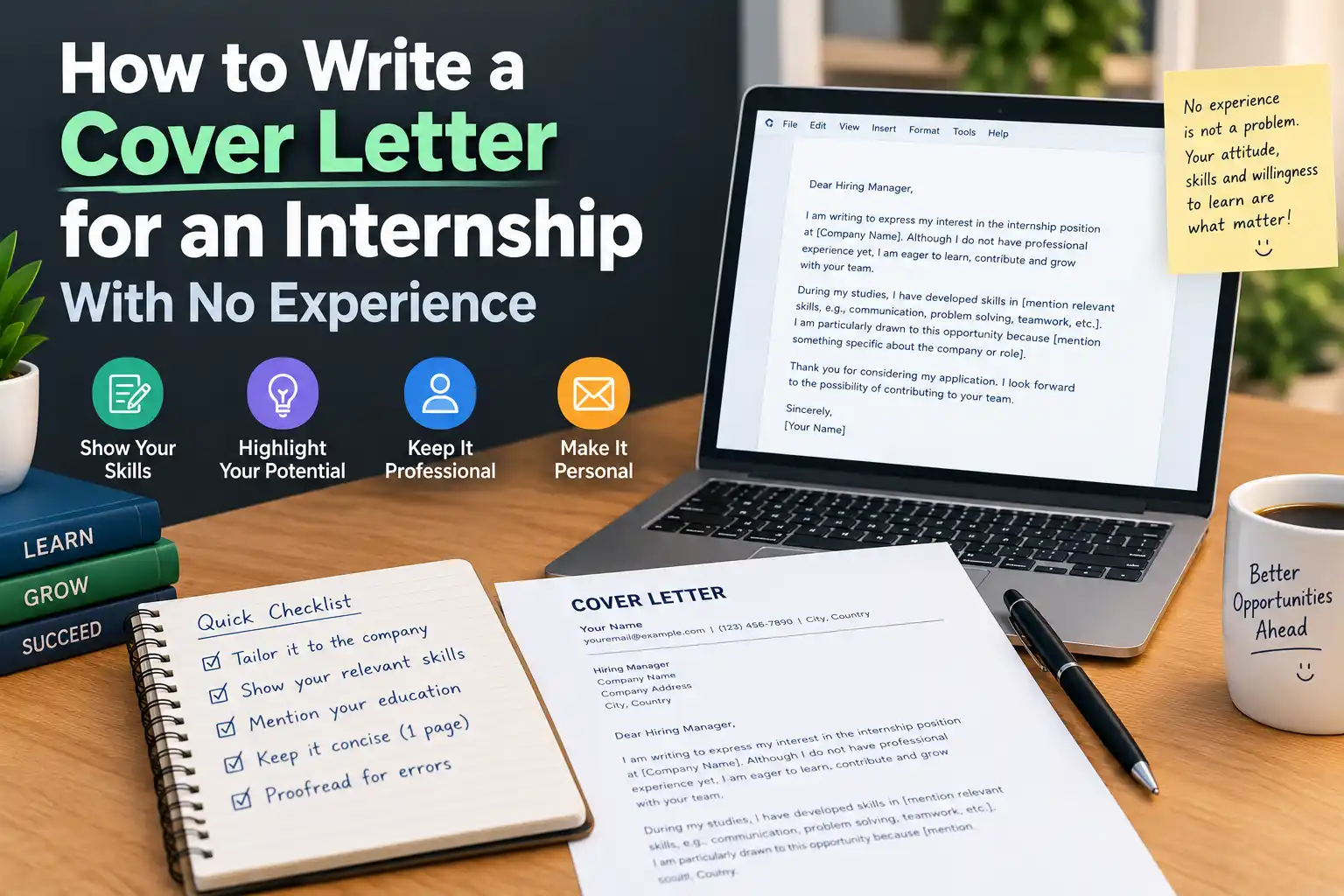
How to Write a Cover Letter for an Internship With No Experience
You open a blank document to write your first cover letter. You type “Dear Hiring Manager,” and then… nothing. What are you supposed to say when you’ve never had a job?
Here’s the secret recruiters won’t tell you: they know you don’t have experience. That’s the whole point of an internship. They’re not looking for a track record. They’re looking for signs you’ll learn fast, show up, and care.
Your cover letter just needs to show those signs.
What to write about instead of work experience
You’ve done more than you think. Look through this list:
- Class projects where you built, researched or presented something.
- Group work where you organised people or met a deadline.
- Clubs and societies, especially if you held any role.
- Volunteering, even a single event.
- Family business help, tutoring younger students, freelancing on Fiverr or Upwork.
- Things you taught yourself: a coding course, Canva designs, a YouTube channel, a small online shop.
Pick the two that match the internship best. Not all six.
A simple structure (four short paragraphs)
Paragraph 1: Who you are and why this company. Name the role. Then one honest line about why this company, not just any internship. Look at their website or LinkedIn. Find something specific.
Paragraph 2: Your best proof. One project or experience, told briefly. What you did, and what came out of it. Numbers help: “a survey of 120 students”, “a website that got 500 visits in its first month”.
Paragraph 3: What you’d bring. Link your skills to what the listing asks for. If they want Excel, mention where you used it. If they want communication skills, point to a presentation or a society role.
Paragraph 4: A short, confident close. Thank them, say you’d welcome an interview, and stop.
Keep the whole thing under one page. 250 to 350 words is plenty.
Example cover letter
Dear Ms. Rahman,
I’m a second-year BBA student at [University] and I’d like to apply for the Marketing Internship at [Company]. I’ve followed your campus ambassador campaigns on Instagram for a while, and the way you turned student reviews into short videos is the kind of marketing I want to learn.
Last semester, my team ran a small campaign for our university’s food festival. I managed our Instagram page, planned posts for three weeks, and tracked what worked. Our reach grew from about 300 to over 4,000 accounts, and the event sold out two days early.
Your listing mentions content planning and basic analytics. I’ve used Canva and Instagram Insights regularly, and I’m comfortable in Excel for simple reports. I’m also the kind of person who asks a lot of questions in week one so I can work independently by week three.
Thank you for reading. I’d be glad to talk about how I could help your team this summer.
Sincerely, [Your Name]
Notice what it doesn’t do. It doesn’t apologise for having no experience. It doesn’t list every skill. It tells one real story and connects it to the job.
Mistakes that get cover letters ignored
- “I am writing to apply for…” as the opening line. Everyone does it. Start with something about the company or you.
- Copying your CV. The cover letter adds context. It doesn’t repeat your bullet points.
- Sending the same letter everywhere. Recruiters can tell. Change at least the first and third paragraphs.
- Typos. One spelling mistake in the company’s name and you’re out. Run it through a grammar checker and read it aloud once.
- Being too humble. “I know I don’t have much to offer, but…” Delete this sentence wherever you find it.
Using AI without sounding like AI
An AI draft is a decent starting point when you’re staring at a blank page. Our AI Cover Letter Writer gives you one in about half a minute. Then make it yours: swap in your real project, your real numbers, and the specific reason you like this company. That specific detail is the thing a recruiter remembers.
And if the company asks you to email your application, the Professional Email Writer helps with a short, polite email to go with it.
FAQ
Do internships even read cover letters? Many do, especially smaller companies. A good one can move you up the pile.
Should I mention my GPA? Only if it’s strong and the listing asks for it.
What if I don’t know the recruiter’s name? “Dear Hiring Team” is fine. Try LinkedIn first, though.